What’s the Plan for Your Street Photography in 2026?
2026 is here. It didn’t arrive with much ceremony. But it did arrive with the same question I face every year: what am I really planning to do with my street photography?
Why “Just Shooting” Isn’t a Plan Anymore
I suspect many of us simply go out and shoot in our free time, when it’s not tied to travel or a specific meetup. Street photography, after all, means dealing with chaos and the unknown. There’s no guarantee that any given session will produce something worth keeping, let alone sharing.
But not planning our street photography comes with a cost. When we tell ourselves that we can’t control what’s out there, we start lowering our expectations before we even begin. We go with the flow, shoot what’s in front of us, and hope for the best. That’s the first mistake.
While we can’t control the street, we can control how we engage with it. We can decide what we’re looking for, what we’re willing to ignore, and when a moment is worth pressing the shutter. Planning doesn’t eliminate unpredictability, but it introduces intention. And intention is one of the few things we can control completely.
What a “Plan” Actually Means
Let’s start by clarifying what a plan doesn’t mean. It doesn’t mean simply going out to shoot. It doesn’t mean “going with the flow.” And it doesn’t mean passively accepting whatever the street happens to present that day.
It also doesn’t mean settling.
A plan for street photography means something else entirely. It means approaching a session with intent, even if that intent is modest. It means deciding, ahead of time, what you’re interested in paying attention to and what you’re willing to ignore. That might be a particular kind of light, a certain gesture, a recurring interaction, or even a problem you’re trying to solve visually.
Planning doesn’t strip street photography of spontaneity. It sharpens it. When you know what you’re looking for, you recognize it faster. You react with more confidence. You stop chasing everything and start committing to something.
At its core, a plan is simply a set of decisions made in advance. Not rigid rules, not shot lists, but priorities. And those priorities are what separate aimless wandering from purposeful work.
One City, One Area, One Problem
“The real voyage of discovery consists not in seeking new landscapes, but in having new eyes.”
For those of us who have easy access to urban environments, the idea of focusing on one city, one area, and one problem is something we shouldn’t take for granted. In fact, it’s what I would consider essential for building an expansive body of work.
To return to the same neighborhood repeatedly, over days, weeks, months, and even years, will reward a street photographer with something more than isolated images. It builds familiarity, anticipation, and eventually recognition. But if you decide to add “the problem” to the mix, it sharpens that familiarity into a point of view.
What constitutes a problem?
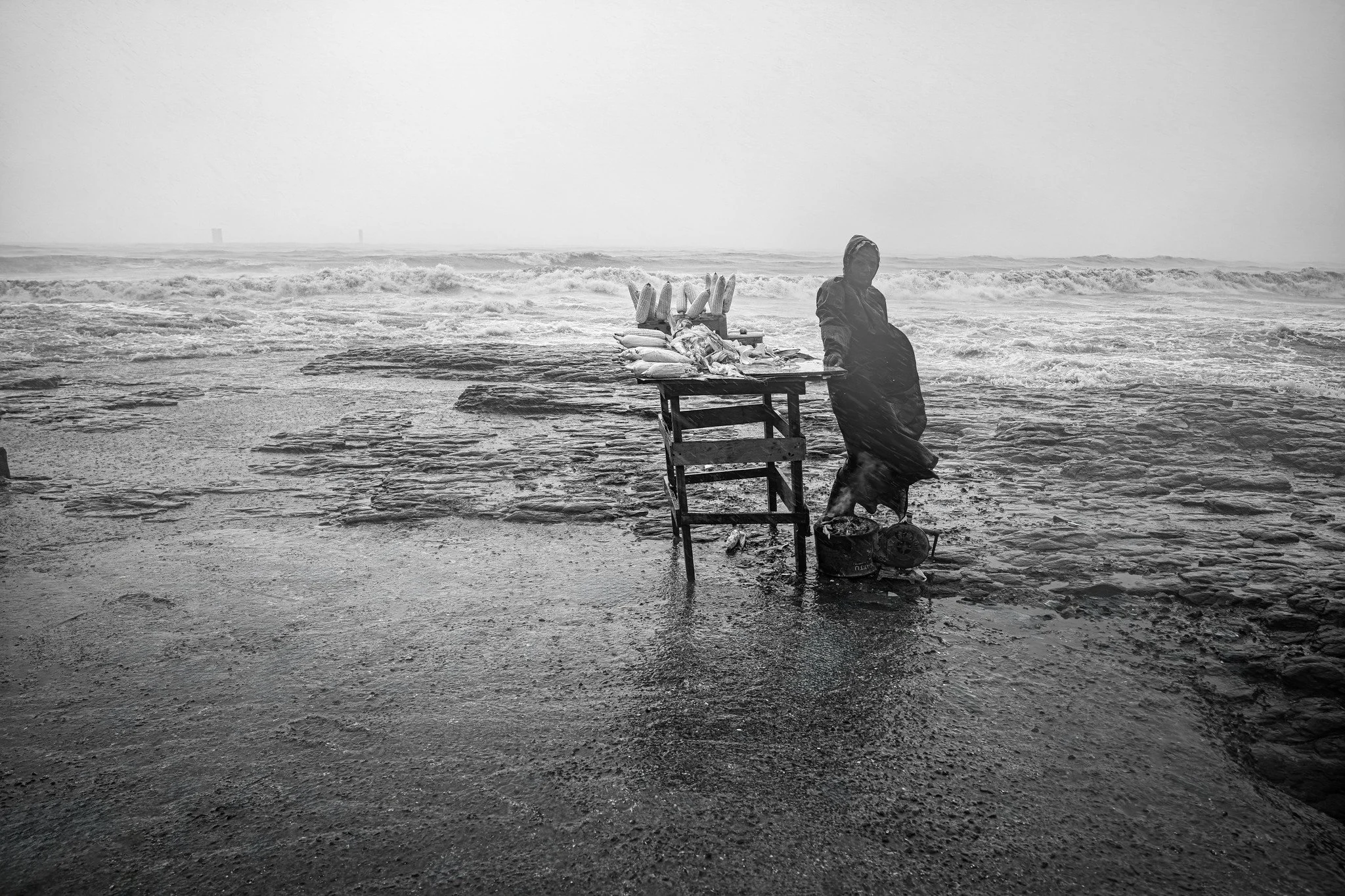
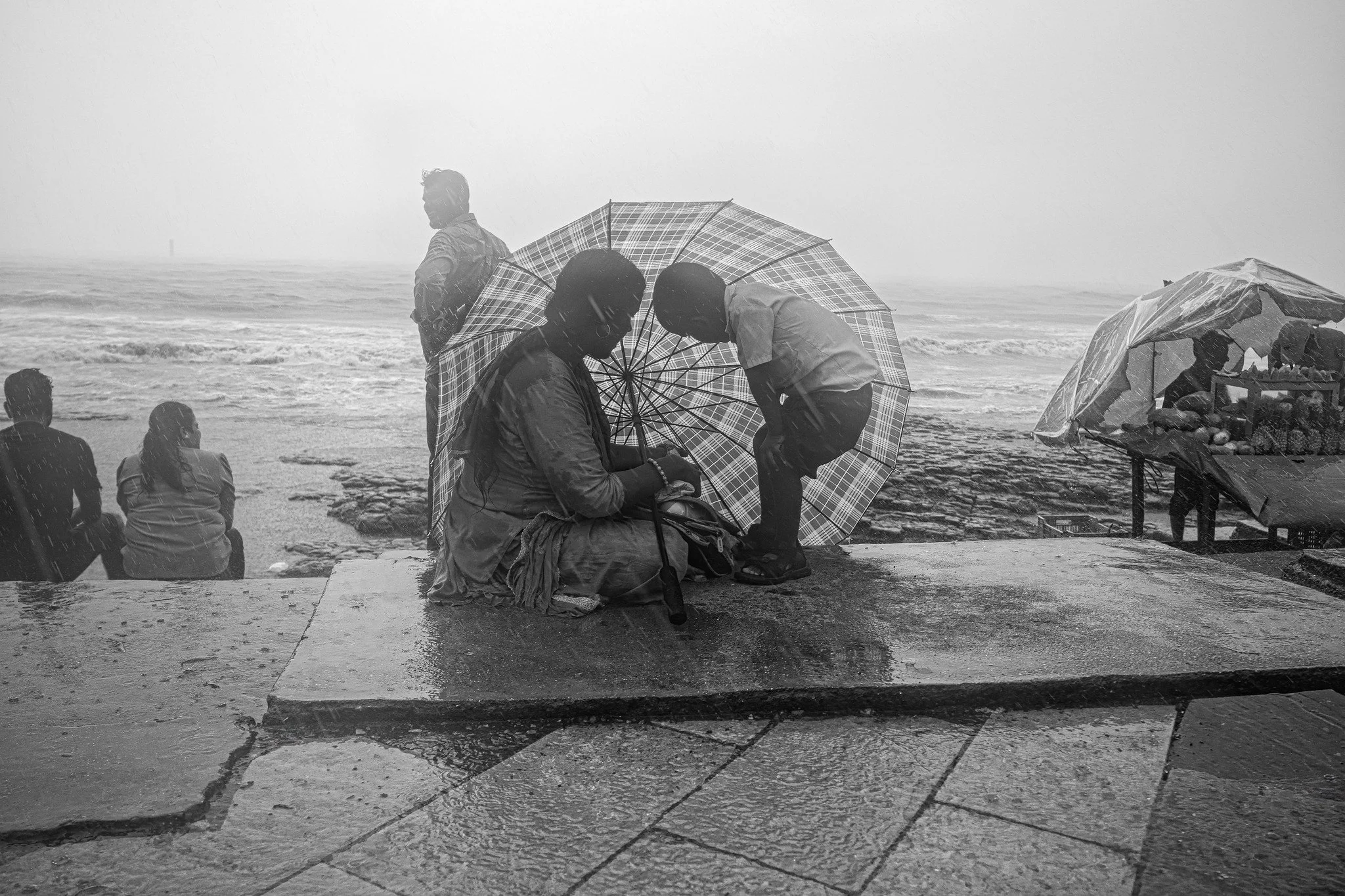
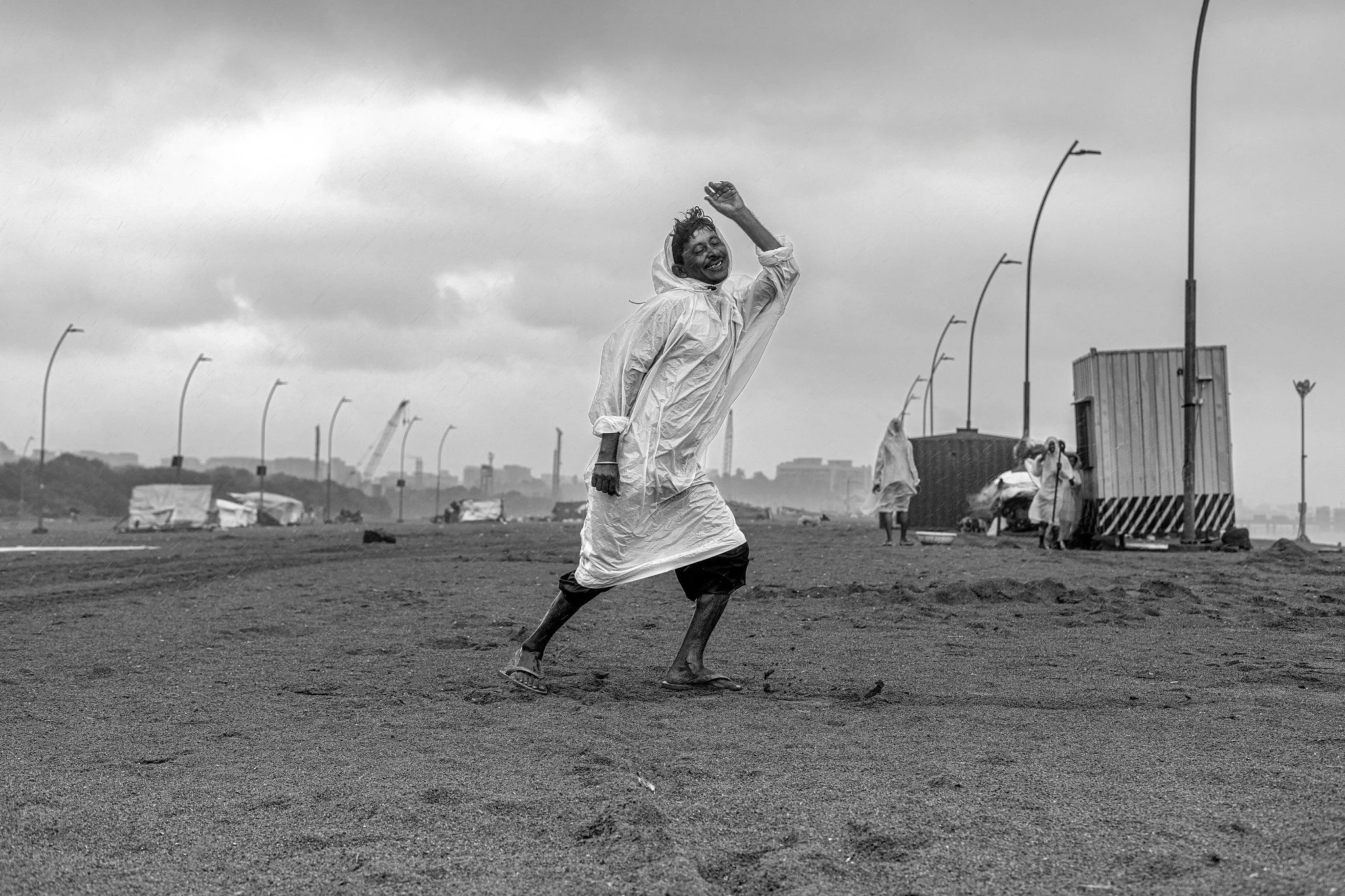
A problem can be something as routine as the morning grind to work or the evening rush home. It can be shooting during inclement weather that inevitably changes how people dress, move, and negotiate space, as with the monsoon season in Mumbai. It can be a specific window of time when a market is at full capacity and movement becomes negotiation rather than flow. Typically, a problem is anything that disrupts the default rhythm of walking, forcing people to adapt.
Some examples of problems might look like this:
Congestion: Commuters packed shoulder-to-shoulder at a crossing that never fully clears.
Heat: Office workers pausing under a flyover, wiping sweat before continuing on.
Rain: People sheltering under shop awnings as traffic pushes through flooded streets.
Waiting: Passengers stuck in traffic on a bus, faces pressed toward the windows.
Transition: Workers changing shoes at the edge of a construction site before heading home.
Obstruction: Pedestrians forced into the road by sidewalk construction.
Fatigue: Vendors slumped on plastic chairs at closing time, hands idle.
Surveillance: Bags opened and movements slowed at a security checkpoint.
Improvisation: Plastic sheets tied between poles to keep a stall dry.
Compression: Rush-hour train doors closing against bodies still trying to enter.
Exposure: Laborers resting in direct sun with no shade nearby.
Friction: Arguments breaking out as two streams of traffic compete for the same narrow lane.
The value of working this way isn’t novelty. It’s recognition.
Time Is the Advantage
I suspect some readers are already objecting. Not everyone lives in a large, dense city, and not everyone feels surrounded by constant visual stimulation. Small towns can feel repetitive, quiet, even boring. It’s easy to assume that meaningful street photography requires scale, density, or a steady supply of “interesting” activity. I understand the sentiment completely. I had lived in small towns in my past before moving to the megacity of Mumbai.
But time works the same way everywhere.
Time is the one advantage street photographers rarely acknowledge, even though it’s the one most readily available to anyone who stays put. Not time in the abstract sense, but accumulated time in a specific place. The kind that comes from walking the same streets often enough that they stop feeling new.
Patterns begin to surface not because you’re looking for them, but because they repeat. You start to recognize when certain people appear, when certain gestures emerge, when light hits a wall for only a few minutes before disappearing again. You learn when nothing happens, which is just as important as knowing when something does.
Time also removes urgency. When you know you’ll be back tomorrow, or next week, or next month, you stop forcing photographs. Missed moments lose their sting. You begin to wait rather than chase. Decisions become quieter and more deliberate.
This is where intention and patience intersect. Noticing patterns is only half the equation; trusting that they’ll return is the other. Over time, the street reveals its habits. And once you understand those habits, you can position yourself within them rather than reacting blindly to whatever unfolds.
Time doesn’t guarantee better photographs. But it does offer something more valuable: familiarity. And familiarity, applied with attention, is what allows a body of work to take shape instead of remaining a collection of isolated moments.
Editing Is Where the Work Reveals Itself
“Those who want to be serious photographers, you’re really going to have to edit your work. You’re going to have to understand what you’re doing. You’re going to have to not just shoot, shoot, shoot. To stop and look at your work is the most important thing you can do.”
Before going any further, it’s worth making a distinction. When photographers talk about “editing,” they’re often talking about two very different things. One is photo editing in the technical sense: culling, color correction, contrast, cleanup. The other is editing in the editorial sense: selection, grouping, sequencing, and decision-making. This section is about the latter.
Without a plan in the edit, you’re doing the same thing you do when you walk the streets without intention. You’re reacting. You’re responding to what feels good in the moment. You’re making decisions in isolation. And just like aimless shooting, that approach produces volume, not direction.
Going home and culling your images is necessary, but it isn’t enough. Post-processing them until they look polished isn’t enough either. Neither is sharing a handful of unrelated images on Instagram and calling it progress. Those actions move files forward, but they don’t move the work forward.
Editing, in the editorial sense, is where patterns become visible. It’s where you begin to notice that certain gestures repeat, certain spaces reappear, certain tensions keep resurfacing. It’s where you realize that some images only make sense when they’re seen alongside others, and that some images you liked on their own actively weaken the larger whole.
This doesn’t require a formal personal project. It can be as simple as reviewing a month of work and asking why certain images feel connected, or why others don’t. It can mean grouping photographs by place, by time of day, by recurring problem, or by visual constraint. It can mean removing technically strong images because they don’t belong to what’s forming.
A body of work doesn’t need to be declared. It doesn’t need a title or a deadline. And it certainly isn’t defined by metadata sitting quietly in a folder. A body of work emerges through repeated editorial decisions. Through choosing coherence over novelty. Through resisting the urge to treat every image as a standalone event.
This is where intention finally becomes visible. Not in the moment of capture, and not in the final polish, but in what you decide to keep, what you decide to remove, and what you allow to sit next to what. That’s where direction is established. And without it, all the time spent walking and shooting simply dissolves into noise.
What Success Looks Like for Our Street Photography in 2026
“Wandering gets you to the next street and then the next. The streets are the canvas. The camera is the brush. Without intention, the artist never shows up.”
As the calendar pages fall off into the second half of January, I find myself thinking through all of this more deliberately. I have a list of neighborhoods I want to return to. I have a number of problems I want to explore visually. And I want to formulate at least a general plan for my first serious street photography sessions of the year. That part has been delayed by a stubborn knee issue that’s kept me off the streets longer than I’d like, but the thinking hasn’t stopped.
Looking back through my archive, one gap has become increasingly obvious. I haven’t spent much time photographing the city at night. I’ve always known this. I’m a morning person. That’s when I’m most alert, most patient, and most optimistic. Morning light works in my favor, especially in Mumbai, where traffic alone can turn a sunset shoot into an hours-long ordeal. After dark, I’ve largely opted out. Some of that is logistics. Some of it is habit. And some of it, if I’m being honest, is simple disinterest.
But disinterest doesn’t mean absence. The more I sit with it, the more obvious it becomes that the city at night holds an entirely different rhythm. Movement changes. Energy compresses. Light stops flattering and starts fragmenting. There are patterns there I’ve barely touched, let alone understood.
This year, I want to change that. I want to explore nighttime routines more deliberately. I want to work artistically with motion, with blur, with long exposures and ICM, not as effects, but as tools for responding to how the city behaves after dark. I’m not setting out with a declared project or a fixed outcome. The plan is simpler than that. Shoot consistently. Edit slowly. Look for repetition. See if certain spaces, gestures, or conditions begin to assert themselves. And if they do, narrow the focus further.
That, to me, is what progress looks like. Not volume. Not visibility. But a growing sense of direction that comes from paying attention over time and making conscious decisions about where to return and what to pursue.
Double-click to edit...