Why I'm Making Music With AI (And Why I'm Not Apologizing for It)
I've been writing songs for most of my life. I was a poet first, then a singer-songwriter, then a guy who learned enough guitar to get himself into trouble. I never exactly made it. There wasn't a record deal, no tour bus, no screaming fans waiting outside a venue for me to emerge from a suspiciously dark alley. I wrote songs anyway. I still do.
I've got decades of that stuff sitting around. Old cassette tapes. Notebooks. Lyrics I'd forgotten I'd written. Melodies I've carried around in my head for years. Some of those songs were recorded as crude demos because that's all I could afford at the time. Others never got recorded at all. They were songs I wrote, played for myself, and then mostly put away because turning them into finished recordings required time, money, musicians, and a level of production I simply didn't have access to.
AI changed that for me. My original intention was to bring those old cassette recordings back to life. Once I started working with Suno, I began learning how to collaborate with it through experimentation, trying different arrangements, instruments, tempos, structures, and production ideas. That eventually led me to writing new music around lyrics and ideas I already had, too. Sometimes I start with an old demo, sometimes with lyrics I've written, and sometimes with a melody or rough idea. What began as an attempt to revive music that had been sitting on cassette for years has become a way to experiment with what those songs, and new ones, might become without booking a studio or assembling a group of musicians every time I have an idea.
I've made plenty of music that should probably be locked in a small room and never allowed outside. That's part of the process. I make something, listen to it, change it, try something else, sometimes spend an absurd amount of time getting a bass line to do exactly what I want, and eventually decide whether it's worth keeping. The fact that a machine is involved doesn't make those decisions for me.
I was initially reluctant to talk too loudly about using AI because I knew exactly what the reaction would be. The arguments have become so polarized that sometimes it seems like admitting you used AI is enough to get you thrown into one of two camps. You're either supposedly destroying human creativity, or you're supposed to pretend the technology isn't doing anything interesting at all. Neither position makes much sense to me.
There's also a line I think is pretty clear when it comes to how this technology should be used. I don't think anyone should have their voice cloned without their consent. And I'm not talking about musicians specifically. If somebody wants to use my voice, my likeness, or some recognizable part of my identity to create something, I'd want to have agreed to it. That's fundamentally different from me using AI to make my own music. If a musician, actor, or anyone else knowingly agrees to a deal allowing their voice to be used to create new work under defined terms, that's a different situation. I don't get to decide that their choice is morally wrong simply because I wouldn't make the same deal. The questions then become what exactly they consented to, how broadly the agreement's written, how long it lasts, and whether it actually covers whatever technology exists in the future.
I'm not trying to impersonate somebody else. I'm trying to make my own music. I'm also not trying to replace professional musicians. I have enormous respect for people who've spent their lives learning an instrument, developing a voice, performing onstage or working in studios. I've done some of that myself, and I know enough about music to appreciate how difficult it can be. But I don't accept the idea that you have to follow the traditional path in order to have something worth saying. If AI gives me a way to take songs I've been carrying around for thirty years and finally turn them into finished recordings, I'm going to use it.
I can distribute those recordings myself. I don't need a label to decide which songs are worth releasing. I don't need to convince a producer to spend money on an artist who might never make that money back. I can experiment, finish something, hate it, throw it away, and start again. I can also make something I genuinely love and put it out into the world.
That's what AI's given me: another way to get back to music I've been carrying around for years. I've spent enough of my life wondering what some of those old songs might've sounded like if I'd had the resources to finish them properly. Now I have a way to find out. The technology hasn't taken music away from me. It's given me another chance to make it.
And I'm not going to apologize for that.
What Is AI Music and How Does AI-Generated Music Work?
I first heard about Suno from a friend. I signed up, started messing around with it, and was pretty much immediately amazed at what the technology could do. I don't mean amazed in the abstract, like, “Wow, the future is here.” I was sitting there listening to this thing make actual music and thinking, holy shit, this is already possible? And this is the infancy of the technology. If this is what we're capable of doing now, what the hell is this going to look like five or 10 years from now? That was the part that really grabbed me.
I've been writing songs for most of my life, so I came to AI music with a backlog. I've got dozens of old cassette tapes from the 1990s containing songs I'd written and recorded. Some are complete songs. Others are little scraps of ideas that never went anywhere. Those tapes represent years of writing, playing, singing, and recording. Some songs had a beginning, middle, and end. Others were basically musical sketches. At the time, turning one of those ideas into a finished recording meant finding musicians, booking studio time, paying for it, and somehow getting everybody into the same room long enough to make it happen. That gets expensive very quickly, especially when you're not a professional musician with a record label paying the bills.
Suno changed that equation for me. I can write a new song and use it as a starting point. I can take lyrics I've already written and build music around them. I can take an old song that's been sitting on a cassette for 30 years and hear what it might sound like with a completely different arrangement. My starting point can be a finished song with lyrics and a melody, or it can be an idea that never got much further than a few lines and a guitar. The technology gives me a way to move between those things without having to recreate an entire recording studio every time I have an idea.
My process is much more hands-on than simply asking the software to make something and accepting the first result. I'm bringing my own lyrics and musical ideas into the process, then listening carefully to what comes back. I change prompts. I change arrangements. I reject generations and try again. I'm listening for a bass line that isn't doing what I want, a vocal phrase that doesn't fit or a chorus that doesn't have the impact I'm looking for. I'm trying to get somewhere specific, and the machine is part of the process of getting there.
That process can eat up hours. I'm always a little nervous when that happens because it usually means I've hit a disconnect, and a big one, between what I'm hearing in my head and what the AI is giving me. There's something I'm trying to communicate that either my instructions aren't making clear or the system isn't capable of understanding well enough. I can keep changing things and generating another version, but eventually I have to recognize that I'm asking the technology to do something it may not be able to do. That's one of the limitations of AI music that people who've only played with it for five minutes probably don't appreciate. Generating something isn't necessarily the hard part. Getting it to do the specific thing you actually want can be the hard part.
The back-and-forth is also where a lot of the interesting stuff happens. I can get exactly what I wanted on the first generation, which is great, but the machine can also give me something I never would've thought of myself. An unexpected arrangement can change the direction of a song. A strange musical idea can suddenly make sense. A result can completely miss the point and send me back to the drawing board. I'm making decisions throughout the process, and those decisions determine what eventually stays in the song.
That's how I think about the machine as a collaborator. It isn't a person, obviously, and it doesn't have an emotional investment in the song. It doesn't know what some old lyric means to me or why I wrote it 30 years ago. It doesn't have memories of the subject I was writing about or the circumstances that produced the song. I do. But it gives me something to react to. I make a decision, it gives me a result, I respond to that result and we keep going. That's a creative process, even if one of the participants happens to be a machine.
Musicians have been dealing with technology changing the process of making music for a long time. Electronic instruments went through a remarkably similar period of suspicion. Synthesizers were criticized as artificial and inauthentic, and there were genuine fears that they'd replace musicians rather than give musicians another instrument. In Britain, the Musicians' Union campaigned against the use of synthesizers and other electronic technology in the 1980s because of concerns about jobs. Drum machines provoked similar arguments, with musicians worried that machines could replace human drummers. There was even a period when the use of drum machines could get musicians excluded from competitions because they weren't considered equivalent to having a human drummer.
We've heard that argument before. The machine is doing something that a human used to have to do, so the human supposedly isn't making music anymore. A synthesizer wasn't considered a “real” instrument because it didn't work like a piano or guitar. A drum machine wasn't a “real” drummer because there wasn't a person sitting behind it. Those arguments didn't survive. Synthesizers became legitimate musical instruments. Drum machines became part of popular music. Computers eventually became fundamental to recording and production. Technology expanded the range of things musicians could do.
AI's obviously a much bigger technological leap than a synthesizer. A synthesizer doesn't listen to your song and generate an entirely new arrangement. A drum machine doesn't write a bass line. Generative AI is operating at a much higher level of the creative process, and that raises serious questions about copyright, compensation, and employment. Those questions deserve serious answers, particularly when technology starts performing tasks that used to require people.
There's another question underneath all of that: does using the technology make the resulting music less legitimate? I don't believe it does. I can use AI to take a song I've been carrying around for 30 years and finally turn it into something I can hear, revise, and release. I can experiment with arrangements that would've been too expensive for me to record in a studio. I can spend hours chasing a particular sound and throw the whole thing away if it doesn't work. I can also discover something I never would've thought of on my own and decide that it makes the song better. The machine can contribute a substantial amount to the finished recording while I remain the person making the creative decisions about where the song goes.
I've spent decades writing songs that never became finished recordings because traditional production was too expensive or simply unavailable to me. Now, I can take those songs and start doing something with them. I can experiment, fail, make something ridiculous, and throw it away. I can find an arrangement that never would've occurred to me. Most importantly, I can finally hear what some of those old songs might've become if I'd had access to this technology when I wrote them.
That's what AI music is to me. It's another instrument and another production environment. It's a way of getting a song out of my head and into the world, even when I don't have a studio full of musicians sitting around waiting for me to figure out what the hell I want them to play. Considering how long some of those songs have been waiting, I'm perfectly happy to use it.
Does AI Music Make You Less of a Musician?
Ask Paul McCartney.
In 2023, The Beatles released “Now and Then,” a song that had originally been recorded by John Lennon as a rough home demo in the late 1970s. Modern machine-learning technology was used to isolate Lennon's voice from the original recording so it could be properly mixed and incorporated into the finished track. Paul McCartney and Ringo Starr then completed the recording using material from the earlier sessions, including George Harrison's guitar work. The technology didn't invent a new John Lennon performance. It made it possible to separate and clean up something that already existed.
Nobody seriously argues that McCartney and Starr stopped being musicians because a computer helped them finish a Beatles song. In fact, the technology allowed them to do something that would've been extremely difficult, if not impossible, with the tools available when Lennon originally recorded the demo. That example is obviously different from what I'm doing with Suno, but I think it makes an important point. Technology has always changed the way musicians make music, and the presence of a machine somewhere in the process doesn't automatically erase the person who started the song, made the decisions, and decided what the finished work should become.
I consider myself a musician, although I'm not much of a performing musician anymore. I still play guitar occasionally, and I can certainly hold my own around a guitar, but I haven't spent the last 30 years developing the chops necessary to walk into a room with a group of professional musicians and keep up with them. That's simply not my life anymore. I'm a songwriter first, and I've always been more interested in the song than in demonstrating what I can physically do with an instrument.
Suno has changed my relationship with music production much more than it's changed my identity as a musician. I still write the songs, I still make the decisions, and I still know what I want a song to sound like, even when I can't always explain it well enough for the software to reproduce it. I listen to what comes back, decide what works, change what doesn't, and keep pushing until I get somewhere I like. The fact that the production tool can now generate parts I couldn't physically play doesn't make the underlying song any less mine.
I've also never been particularly interested in deciding who gets to call themselves a musician. If somebody has never played an instrument and knows very little about music theory, then spends an afternoon working with an AI system and comes up with something they love, good for them. They're making music. Whether I'd personally describe them as a musician is another question, but I don't see much value in standing at the door and checking everybody's credentials.
What interests me is the assumption that because AI can perform some of the work traditionally handled by musicians, the person using it must somehow become less legitimate. There’s a huge range between typing a generic prompt, accepting the first result and uploading it, and spending hours developing a song that began with your own idea. The software might be identical, but the creative process can be completely different. Human involvement exists on a spectrum, and pretending every AI-generated song involves the same amount of creative input doesn't make much sense.
The same thing happens in photography. I shoot RAW because I want control over what happens after I press the shutter. My camera is already doing an enormous amount of work before the image ever reaches Lightroom or Photoshop. Autofocus is making decisions, the exposure system is making decisions, and the image processor is making decisions. None of that makes me less of a photographer. The camera is a tool, and the fact that it's doing some of the technical work doesn't erase the person standing behind it.
AI music gets more complicated because the machine can generate a much larger portion of the finished material. That's where the real debate begins. If I write a lyric, come up with a melody, decide how I want the song to feel, and then use AI to generate the instrumental and vocal parts, I haven't physically performed every part of the finished recording. That's true. But physical performance has never been the only form of musical authorship.
There are musicians who've spent years writing songs they don't personally perform on every recording. Producers shape performances, session players contribute parts, and engineers transform recordings. A singer can write a song and have somebody else play every instrument on it. Nobody listens to the finished record and says, “Well, technically you didn't play the bass, so this isn't really your song.” The person who wrote the song can remain the songwriter, even when other people contribute substantially to the finished recording.
AI complicates that relationship because the performer is software rather than another human being, but the creative role still exists. Someone has to decide what the song is supposed to become, listen to the results, recognize when something works, and figure out what stays. In my case, that's me.
I've been writing songs for decades, and I've got unfinished songs, old lyrics, melodies, and ideas that have been sitting around for years. When I bring those things into an AI music system, I'm bringing a history with me. I'm trying to get the technology to produce something that exists in my head, even when I can't always explain exactly what I'm hearing. That process can take hours, especially when the system keeps getting close to what I want without quite getting there.
Then there are the moments when the machine surprises me, and those can be some of the best parts of the process. I might have an idea for an arrangement and get something completely unexpected that somehow makes the song better. I might hear a melody I wouldn't have thought of myself and decide it belongs. Or the software can completely fuck up what I'm trying to do and send me back to the drawing board. Either way, I'm making decisions throughout the process, and those decisions shape the finished recording.
That's why I think the better question is what I'm doing with the technology. I've got songs that existed long before AI music software did. I wrote them, played them, and recorded rough versions of them on cassette. Those years of songwriting didn't disappear because I found a new way to produce the recordings. If anything, AI has given that part of my musical life another lease on life.
I can finally take some of those songs and find out what they sound like as finished recordings. I can experiment with arrangements I never would've been able to afford, and I can chase an idea without booking a studio or finding four musicians who all happen to be available on the same Tuesday. When the technology produces something good, I still have to recognize it, decide that it belongs in the song, and figure out what needs to happen next.
A machine can generate an enormous amount of material, but it doesn't decide which version of my song I actually want to keep. That's still my job. I've been a musician for most of my life, and these days, AI happens to be part of the way I make recordings. The instrument has changed, the production process has changed, and the possibilities have changed, but I'm still the person sitting down with a song and trying to turn it into something worth hearing.
How AI Is Democratizing Music
How AI Is Democratizing Music
I've already lived through one version of what it meant to make a record when you didn't have much money. In the early 1990s, I was in a band, and we booked a couple of recording sessions at Triad Studios in Redmond, Washington. We were paying for everything ourselves, and studio time was more than $100 an hour, which was serious money for us at the time. Split between four people, it was still expensive, and every minute in the studio mattered. You didn't walk in just to see what might happen. You walked in knowing the clock was running.
That changes the way you make music. When every experiment costs money, you become much more careful about experimenting. You rehearse before you record, you make decisions before you get into the studio, and you try to avoid wasting an hour figuring out whether some bizarre arrangement might work. You certainly don't record six versions of a song just because you're curious about what the sixth version might sound like. The economics of recording put a limit on creativity, whether you wanted them to or not.
AI removes a huge part of that barrier. There’s now an astonishingly short distance between having an idea for a song and having something you can actually listen to. I can write something in the morning, start building it with AI, and have a version of it that afternoon. If it doesn't work, I can try another approach. If that doesn't work, I can throw it away and move on. I’m no longer watching a studio clock while I make those decisions, and I’m not paying four musicians to sit around while I decide whether the second verse needs a different arrangement. The technology has effectively removed much of the financial penalty for experimentation.
That's what I mean when I talk about the democratization of music. The technology doesn't suddenly make everyone a great songwriter, and talent hasn't become irrelevant. What it's doing is making production resources available to people who previously couldn't afford them. There are an enormous number of people who can write songs but never had the money or access to musicians and studios needed to turn those songs into finished recordings. AI gives some of those people a way forward that simply didn't exist before.
Whether that leads to discovery is another matter. Making a song is easier. Getting anybody to hear it isn't.
That problem actually goes back a long way. Before the internet, you needed a record label, radio, a distributor, a manager, a publisher, or some other gatekeeper willing to take a chance on you. Then the internet knocked down some of those walls and replaced them with different ones. Now anybody can release music, but everybody can release music. Distribution has become easier, while getting someone's attention has become harder. You can put a song online without asking anybody's permission, but you can't make people listen to it.
AI isn't going to solve that problem. If anything, it's going to make the competition for attention even more ridiculous. There will be more music, more releases, and more noise. A genuinely great song can still disappear into that pile. Making something is only the first part of the problem. Getting somebody to stop scrolling long enough to hear it is another problem entirely.
I've actually come to appreciate the freedom that comes with being able to work alone. I've collaborated with plenty of musicians over the years, and collaboration can be fantastic when you find the right people. It can also become complicated when everyone has different schedules, different ideas about the song, and different levels of availability. If I have an idea at two in the morning, I want to work on it while the idea is still alive in my head. I don't want to spend the next week trying to find a drummer who's available on Tuesday.
AI lets me follow the idea when it happens. That's a big deal for me. If I eventually make something that would benefit from a great guitar player or drummer, I'd happily work with one. If I were putting together a live performance or a commercial project where human musicians were the right choice, I'd want them involved. The technology simply means I don't have to assemble a group of people every time I want to find out whether an idea works.
That's an important part of what democratization actually means here. The old ways of making music aren't disappearing. If you want to learn guitar, join a band, rent a rehearsal room, and record with five other people, you can still do that. If you want to spend years becoming a great instrumentalist, nothing about AI prevents you from doing it. There’s just another path available now, and that path doesn't require you to have the money, connections, or technical resources that used to stand between having an idea and making a recording.
For someone like me, that's pretty extraordinary. I spent years with songs that existed as lyrics, chords, melodies, cassette recordings, and ideas in my head because I couldn't afford to take them any further. Those songs didn't disappear. They just sat there waiting for a set of circumstances that never really arrived. Now I can take them out, work on them, and find out what they might become.
That's the part of AI music that I find genuinely liberating. I can sit down with an old song and start working on it immediately. I can experiment with an arrangement without booking a studio, and I can throw away an idea without having wasted hundreds of dollars doing it. If something works, I can keep going. If it doesn't, I can try again.
AI hasn't made getting discovered easier. It has made getting started easier, and for a songwriter who's spent decades waiting for the circumstances to be right, that's a pretty significant change.
Is AI Music Soulless?
“It's soulless.”
That might be the most common criticism of AI-generated music, and I honestly don't know what people expect me to do with that argument. Is the technology supposed to have a soul? Is there a little electronic spirit living inside the server rack, waiting to be emotionally moved by my lyrics? I understand what people mean when they say AI music feels soulless. They're saying they don't hear the human experience behind it. They hear something generated by a machine and assume there can't be anything genuine on the other side of it. I just don't buy the argument.
Technology doesn't determine whether music has emotion. The person using the technology does. I can make a song with a guitar, a piano, a synthesizer, a drum machine, a computer, or an AI system, and none of those things has a soul. None of them has experienced love, grief, boredom, lust, regret, or the particular kind of stupidity that makes human beings write songs in the first place. The emotional content comes from the person deciding what to make and what to keep.
Take two people sitting on the floor with a couple of sticks. One person bangs them together and makes an irritating noise, while the other somehow creates an interesting rhythm. The sticks aren't responsible for the difference. They're just the tools. Give those same sticks to Paul McCartney, and I'm willing to bet you'll get something considerably more interesting. Give Paul McCartney access to an AI music system, and I'd expect the results to be interesting for an entirely different reason. The tool matters, but the person using it matters just as much.
That's also why the idea that AI music is automatically emotionless doesn't make much sense to me. I've taken some of my own old songs, including songs that have been sitting on cassette tapes for decades, and used AI to turn them into full productions. Hearing some of those songs come back to life with an arrangement and production that I never could've created on my own is an emotional experience for me. The song already had a history. I wrote it, sang it, played it, and lived with it. The technology gave me a way to hear it in a form that had been unavailable to me for most of my life.
That experience is probably the simplest answer I can give to the whole “soulless” argument. Take a song I wrote 30 years ago, put it through an AI music system, and then tell me there's no human emotion in the result. I know exactly where that song came from. I know who wrote the words, what I was thinking about when I wrote them, and how long the song has been sitting around waiting to become something more than a rough recording. The machine didn't create that history. It gave me a way to work with it.
AI also surprises me, and that can be part of the fun. I'll ask for something and get a slightly different melody, an unexpected instrumental part, or an arrangement that takes the song somewhere I hadn't considered. Most of the time, the result goes straight into the trash. Then there are those moments when I hear something and think, that's actually better than what I was trying to do. I don't regard those accidents as evidence that the machine has suddenly developed a soul. I regard them as part of the creative process. Artists have always responded to accidents, mistakes, and unexpected results. AI has simply created a new category of accidents to respond to.
The same thing happens with other tools. A microphone doesn't understand a song. It doesn't know whether I'm singing about heartbreak or my fucking electric bill. It captures the sound. A guitar doesn't understand what I'm playing, and a mixing console doesn't understand why I pushed the vocal three decibels louder. None of those tools have an emotional connection to the music, yet we don't question whether the finished recording can contain emotion. We hear the emotion because a human being put it there.
And no, the AI doesn't understand what I'm singing about. It doesn't need to. That's not its job. I understand what I'm singing about. I wrote the words, and I know why I wrote them, even if nobody else ever does. When I decide that a particular vocal delivery, chord change, bass line, or arrangement fits the feeling I'm trying to express, that's my decision. The machine doesn't have to experience the emotion in order to help me express it.
If a song makes someone feel something, the fact that AI was involved in producing some, or even most, of the sound doesn't automatically cancel that reaction. A listener doesn't have to care about my workflow. They don't need to know how many generations I made or how many prompts I used. They hear the finished song and decide whether it means something to them. That's the relationship between an artist and an audience. The audience experiences the work, not the production log.
That doesn't mean every AI song is going to move anyone. Most won't. Most human-made songs don't move me either. I've listened to an enormous amount of music in my life, and plenty of it has left me completely cold despite being written, performed, and recorded by actual human beings. Human involvement has never been a guarantee of emotional impact. A song either connects with somebody or it doesn't, and the technology used to make it can't guarantee that connection.
The bigger issue for me is control. AI can currently surprise me in ways I like and ways I don't, and I can describe exactly what I want while still getting something that misses the point. That's probably one of the biggest limitations of the technology right now. If I could tell it exactly what I hear in my head and get exactly that result every time, the process would become dramatically more powerful. I suspect we're going to get much closer to that level of control.
When we do, I think the argument about whether musicians have to physically perform every part of a recording is going to become even harder to sustain. There will still be musicians who want to play guitars, drums, piano, and everything else themselves. There will still be people who love recording bands in rooms with microphones. Live concerts will still matter because watching human beings perform in front of an audience is a completely different experience from listening to a recording.
There will also be people like me who want to take an idea and explore what it can become without having to assemble an entire production team every time. That's the part of this technology that I find exciting. I've spent decades carrying songs around in my head, on paper, and on old cassette tapes, knowing there was more I wanted to do with them but lacking the practical means to do it. AI has given me another way to explore those songs. Whether someone else hears a soul in the finished recording is up to them, but I know exactly where the soul of the song came from.
Will AI Replace Musicians?
What happens to the musicians? What happens to the guitar players, drummers, singers, session players, producers, and engineers who make their living doing this work? It's a legitimate question, because AI is going to affect some of those jobs. The real questions are how much it'll change the work, who'll feel the impact first, and what happens to the people whose livelihoods depend on it.
The first thing I'd separate out is what happens in my particular situation. Every time I make a song with AI, it doesn't automatically mean a human musician somewhere has lost a job. If I weren't using AI, I wouldn't necessarily be calling four musicians, booking a studio, and hiring an engineer to make the same song. I wasn't going to spend that money. The song probably wouldn't exist as a finished recording at all. My choice is between making the song with the tools available to me or leaving it sitting on a cassette tape, in a notebook, or in my head. So let’s ditch the false equivalence nonsense, which unfortunately is a big part of the pushback against AI music.
The first thing I'd separate out is what happens in my particular situation. Every time I make a song with AI, it doesn't automatically mean a human musician somewhere has lost a job. If I weren't using AI, I wouldn't necessarily be calling four musicians, booking a studio, and hiring an engineer to make the same song. I wasn't going to spend that money. The song probably wouldn't exist as a finished recording at all. My choice is between making the song with the tools available to me or leaving it sitting on a cassette tape, in a notebook, or in my head.
It’s important when we start talking about lost jobs. If I fix something around my house instead of hiring a contractor, that doesn't necessarily mean I stole a job from a contractor. If I cook dinner instead of going to a restaurant, I haven't put a chef out of work. People do things themselves when they have the ability to do them, and AI is giving me that option with music.
At the same time, professional musicians have plenty of reason to be concerned. If AI becomes capable of handling more of the work currently performed by session musicians, composers, producers, voice artists, and other professionals, there will be economic consequences. Some jobs could disappear. Other kinds of work will probably emerge around the technology. That's what happens when a new technology changes the economics of an industry, and music isn't going to be magically protected from it.
I also don't think musicians should be expected to compete against technology while pretending the technology doesn't exist. If AI can make certain production tasks faster and cheaper, people are going to use it. That's already happening. Telling everyone to keep using the old system simply because the old system provided employment doesn't really solve the underlying problem. Technology has been changing creative work for centuries, and music has always adapted to it.
There’s a practical reality about musicians that tends to get lost in these arguments. Making a living as a musician has never been an especially secure career. According to the U.S. Bureau of Labor Statistics, musicians and singers had a median hourly wage of $47.80 in May 2025, but the occupation doesn't have a meaningful annual wage figure because many musicians don't work year-round or full-time. The Bureau also notes that part-time work is common and that many musicians have periods when they aren't working or have to find other jobs. That's not evidence that musicians aren't valuable. It's evidence that the economic system supporting musicians has always been complicated and precarious.
I mention that because the idea that AI is suddenly taking a stable, comfortable career away from millions of people doesn't quite match reality. For many musicians, the problem has always been finding enough paid work in the first place. AI may make some of that harder, and that deserves to be taken seriously, but it isn't destroying some perfectly functioning economic model that existed before AI arrived.
There are also opportunities that could develop as musicians start using AI themselves. A songwriter could create demos without hiring a studio. A producer could explore arrangements before bringing in human performers. A musician could build an entirely new kind of live show around technology that wasn't available before. Some traditional jobs may disappear, but the creative economy isn't necessarily a fixed pie where every task performed by a machine equals one less human job forever.
And that's where I think the argument gets confused. Professional musicians deserve to be paid for their work. If a company uses someone's voice without permission, exploits their work, or builds a commercial system around their creative output without respecting the legal rights involved, that's a legitimate issue. If laws need to change to protect people from new forms of exploitation, lawmakers should change them. If platforms need better rules, they should create them. Those are questions about the technology industry, the music business, and the law. They're separate from my right to use a tool to make my own music.
I love live music. I love watching somebody who's spent years mastering an instrument walk onto a stage and do something I couldn't begin to reproduce. That's a completely different experience from listening to a recording, whether that recording was made with a full band, a computer, or an AI system. There’s room for both, and appreciating one doesn't diminish the other.
I also think there's a good chance live performance becomes even more interesting as recorded music becomes easier to generate. If listeners are surrounded by an endless supply of recorded material, seeing an actual human being perform in front of an audience could become even more valuable. That could happen, although I'm not willing to treat it as some guaranteed consequence of AI. People have been predicting the death of live music for a very long time, and live music has stubbornly refused to disappear.
The bigger question is what happens when the tools become good enough that a professional musician can use AI as another part of the creative process. An excellent guitarist who understands music and knows exactly what they're trying to create will probably get something very different from the technology than someone who has never picked up a guitar. The same applies to a songwriter, producer, singer, or composer. Experience still matters because knowing what you want is a huge part of making music.
That's also why I don't see AI as the end of musicians. I see it as another technology that musicians are going to learn to use, just as they learned synthesizers, drum machines, samplers, computers, digital recording, and every other tool that changed the way music gets made. Some musicians will embrace it. Some won't. Some jobs will change. Some will disappear. New opportunities will appear in places we can't see clearly yet.
The musicians themselves aren't going away. Neither is the desire to hear a human being perform something extraordinary. I still get a kick out of watching somebody play guitar at a level I'll never reach, and I still have a guitar sitting in my house that I occasionally pick up because there's something satisfying about actually playing it. At the same time, I can sit down with an AI system and create sounds I could never physically produce myself.
That's the part I keep coming back to. AI doesn't have to replace musicians in order to change music. It only has to change what musicians can do. And that's already happening.
AI Music Copyright: Who Owns the Music Used to Train AI?
One argument about AI music goes something like this: AI companies trained their systems on music made by artists without permission; therefore, AI music is stealing; therefore, anyone using AI to make music is participating in that theft. It sounds simple, which is probably part of its appeal. The actual issue is considerably more complicated.
There are several separate questions buried in that argument. Did an AI company train its system using copyrighted music? Did it have permission to use that music? Does using copyrighted material to train an AI model constitute infringement? The answer can depend on how the material was obtained, how it was used, what the resulting system does, and whether the output reproduces protected expression. Then there's another question that gets thrown into the same pile: if an AI company did something legally wrong while developing its system, does that automatically make every person who later uses that system a copyright infringer? These are separate questions, and treating them as one giant accusation doesn't make the argument any stronger.
The legal status of AI training is still being worked out, including in the United States. The U.S. Copyright Office has been examining the issue as part of its work on copyright and artificial intelligence, and the analysis involves questions about fair use and the specific circumstances surrounding how copyrighted works were obtained and used. Fair use isn't a magic button that says “AI is allowed” or “AI is forbidden.” It involves factors such as the purpose and character of the use, the nature of the copyrighted work, how much was used, and the effect on the potential market for the original. Exactly how those principles apply to AI training is something courts and lawmakers are still wrestling with.
I'm perfectly comfortable with that uncertainty. If a court eventually decides that an AI company violated copyright law by training its system on copyrighted music, then the company should deal with the consequences. Pay damages. Change the system. Negotiate licenses. Stop doing whatever the court says was illegal. If lawmakers decide the existing law isn't adequate and create new rules for AI training, the companies will have to operate under those rules. That's how a legal system is supposed to work.
What gets lost in this argument is the difference between the actions of an AI company and the actions of someone using its software. I didn't sneak into a recording studio, steal a master tape of “Yesterday,” and upload it to Suno. I'm using a piece of software that was made available to me, and I'm creating something different with it. If an AI company has a legal problem with how it obtained or used training material, that's a problem between the company, the rights holders, and the law. It doesn't automatically turn every person using the resulting software into a thief.
Musicians have always learned from other musicians. We listen to records. We study guitar players. We pick up little tricks from people we admire. We hear a chord progression and think, “I want to try something like that.” We absorb rhythms, arrangements, production techniques, and melodic ideas from everything around us. That's how music develops. An artist's influence can show up in your work without you reproducing the original work itself.
There’s obviously a line. Deliberately copying somebody else's song and passing it off as your own is one thing. Taking a recording and using an unauthorized sample where permission is required is another. Reproducing protected expression can create a copyright problem regardless of whether a human being or an AI system was involved.
AI makes that boundary harder to see because the technology learns from enormous amounts of existing material. That's a legitimate reason to scrutinize how these systems are built. The question of whether an AI company was legally entitled to use copyrighted recordings for training is one question. Whether a particular AI-generated song unlawfully reproduces somebody else's protected work is another. Whether the person who typed the prompt personally “stole” every piece of music that may have been included in a training dataset is something else again.
Those distinctions become especially important when people talk about AI music as though every person using it is personally responsible for the entire history of the technology. If Suno, or another AI company, eventually gets sued over its training practices and loses, I'll have no problem with the company being held accountable. That's what copyright law is there for. The responsibility belongs with the people and companies whose actions actually created the legal problem.
There's also a moral argument that goes beyond what the law says. Even if using AI is technically legal, shouldn't you feel guilty knowing that the technology was built using other people's work? I understand the question, but I don't see why every decision made by a technology company suddenly becomes the personal moral responsibility of everyone who uses its product.
If I use Photoshop, I'm not personally responsible for every decision Adobe has ever made. If I use a camera, I'm not responsible for every photograph that's ever been taken with that camera. The same principle applies here. The ethics of how an AI system was developed are worth examining, and the rights of artists whose work was used deserve serious consideration. Those issues belong in the conversation about how these systems should be built and regulated.
They don't erase my own role in making a song. I've been writing songs for decades. I bring my own lyrics, melodies, ideas, and old recordings into the process. I make decisions about what the song should become, and I decide what gets kept and what gets thrown away. The fact that the software behind the production was trained on a huge body of existing music doesn't mean that every song I make with it contains somebody else's copyrighted work.
That's where I think the argument needs to become more precise. There are real copyright questions surrounding AI music, and some of them are going to have enormous consequences for musicians. Training rights, licensing, compensation, voice rights, ownership of outputs, and the boundaries of infringement all deserve serious examination. But collapsing all of those questions into “AI music is theft” skips over the actual legal issues.
I'd rather see those questions answered properly than settled by outrage. If an AI company has infringed someone's copyright, let the courts decide. If the law needs to change, change it. If artists deserve compensation for the use of their work, establish a system that actually does that. Those are real issues worth fighting about.
Using AI to make a song, by itself, isn't a declaration that copyright doesn't matter. It’s simply a new way of making music, and the law is now having to figure out where that new technology fits.
AI Music Slop: Is AI-Generated Music Flooding Streaming Services?
AI slop is a real problem. Give people a technology that can produce an enormous amount of content very cheaply and quickly, and somebody's going to use it to produce an enormous amount of crap very cheaply and quickly. That's not exactly a shocking development. Humans have been doing this with every available medium for a very long time. The difference now is that AI makes the process extraordinarily efficient.
What I find harder to accept is the idea that the general public is somehow being held hostage by this flood of AI-generated music. Who, exactly, is being forced to listen to it? How many people are spending their day searching specifically for AI music and then becoming personally offended because they found too much of it? How many are genuinely being fooled into thinking that some random AI-generated song was recorded by a human artist? Those are fair questions, and I think they get closer to the actual problem than the idea that listeners are somehow trapped in an endless stream of AI music.
There's already an enormous amount of music in the world that I don't like. Most of it, in fact, isn't for me. There are genres I can't stand, artists I have no interest in, and millions of perfectly legitimate human-made songs I'll never listen to twice. Nobody has to solve that problem for me. I skip the song, change the station, or listen to something else. The existence of music I don't enjoy isn't an attack on me.
The more serious problem with AI slop is what happens when platforms are suddenly flooded with huge quantities of low-value material. Streaming services and distributors have to process all of that content. They have to store it, categorize it, recommend it, and somehow decide what deserves attention. Then there's the economic question of what happens to royalties when the amount of music being uploaded increases dramatically.
That's a legitimate industry problem, and AI slop can hurt people like me, too. I don't want my music buried under millions of disposable tracks generated by people uploading hundreds of songs a day simply because they can. If I'm spending hours working on an arrangement, rewriting something, trying different ideas and throwing away generations that don't work, competing for attention with an automated content factory is going to be a problem.
The solution, though, isn't to make legitimate AI-assisted musicians feel guilty for using the same technology. The platforms allowed this technology onto their services, and they have the technical ability to figure out how they want to deal with it. They could develop better systems for identifying automated uploads, change recommendation algorithms, impose limits on uploads, require disclosure of AI-generated material, or come up with something better that nobody has thought of yet.
The important thing is that the problem gets addressed at the platform level rather than by pretending every person using AI is part of the problem. If a distributor accepts thousands of tracks from an account every day, the responsibility for figuring out how that affects its platform belongs partly with the distributor. If a streaming service's recommendation system gets overwhelmed by disposable content, that's a problem with the system that needs to be addressed. None of that requires treating the person who spent three hours working on one song as though they're operating the same kind of business.
I also think the scale of the “AI slop” argument can get exaggerated. The internet has always been full of crap. YouTube is full of crap. Spotify is full of crap. Social media is full of crap. Amazon is full of crap. The ability to produce something doesn't mean anybody is obligated to consume it. AI has made it easier to produce enormous quantities of mediocre material, but people are still perfectly capable of ignoring things they don't want.
The bigger issue may actually be curation. When there's too much of anything, the systems that help us find what we actually want become more important. That's where streaming platforms have a real responsibility. If their recommendation systems become so overwhelmed by an ocean of disposable AI-generated material that genuinely worthwhile music becomes harder to discover, they've got a problem to solve.
And there's an irony here. AI slop could make things harder for people like me who are actually spending time developing songs with the technology. I want someone to hear one of my songs and know there was an actual person behind the decisions that shaped it. At the same time, I'm using AI precisely because it gives me a way to make music that I couldn't previously produce on my own. The technology isn't the problem. The industrial-scale production of disposable content is.
I don't blame cameras for bad photographers, and I don't blame Photoshop for bad photographs. The same principle applies here. AI can be used to make something worthwhile, or it can be used to manufacture a thousand disposable tracks before breakfast. The existence of AI slop doesn't tell you anything useful about the quality, effort, or intent behind every other piece of music made with the technology.
If anything, the arrival of AI makes curation more important than ever. The flood of disposable music is going to keep coming, because the economics make it inevitable. The challenge for streaming platforms isn't figuring out how to stop people from making music. It's figuring out how to separate the people who are genuinely creating from the people who are simply filling the pipes because they can. And I'd much rather see the industry solve that problem than pretend the answer is to shut down the technology for everyone.
Who Owns AI-Generated Music?
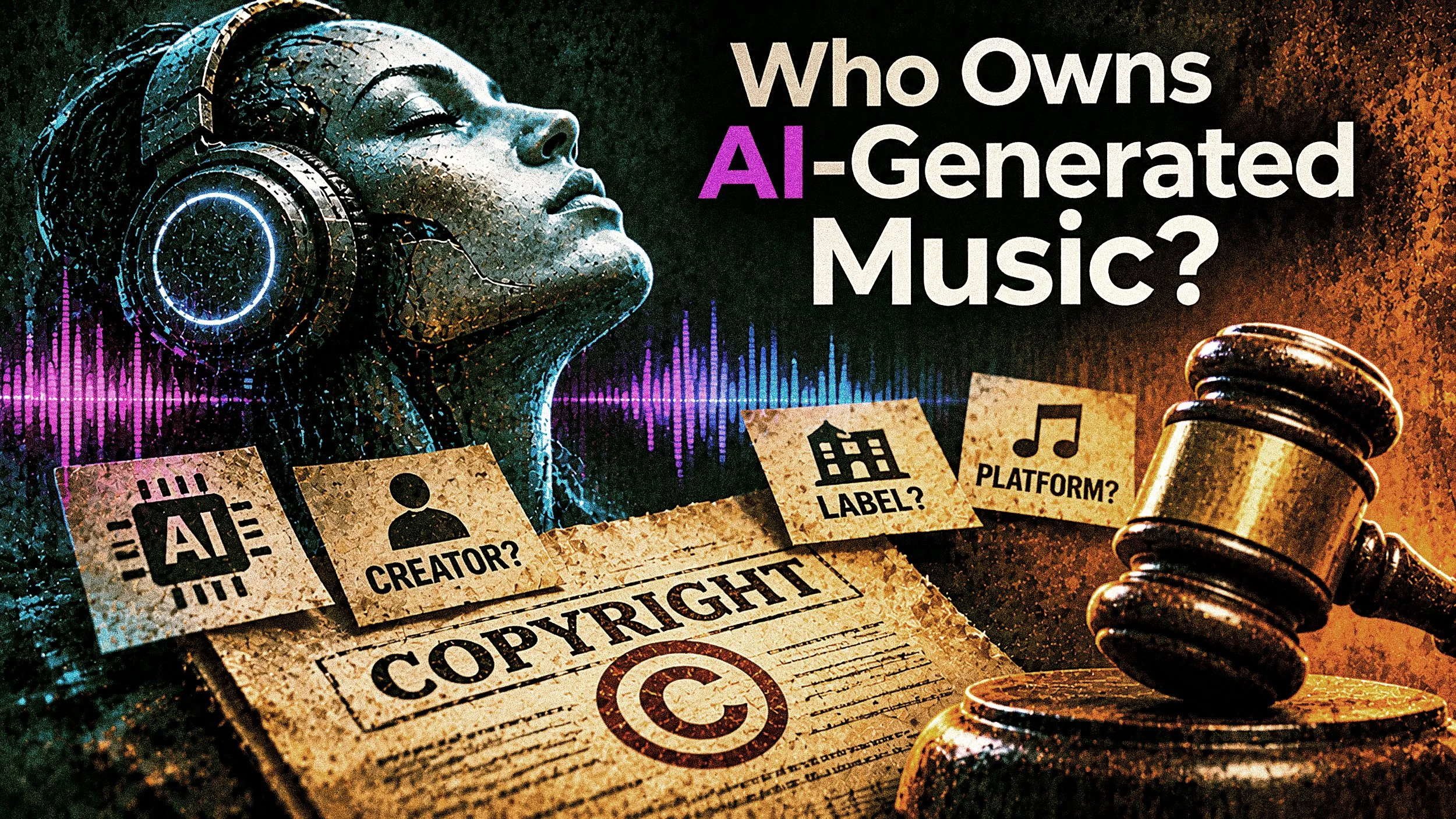
Whose music is it? Well, mine.
That probably sounds like an obvious answer, but once AI enters the picture, ownership gets complicated pretty quickly. If I write the lyrics, create the melody, decide what I want the song to sound like, and then use AI to help produce the finished recording, where does my contribution end and the machine's begin? That's a legitimate question, and the answer isn't simply that anything involving AI automatically belongs to the AI company.
I've already got a pretty good idea of where my own songs came from. I've been writing them for decades. Some started as lyrics in notebooks. Some were recorded on cassette tapes in the 1990s. Some existed as rough demos that never got beyond a guitar and a voice. Those songs existed long before I ever heard of Suno. AI entered the process much later, as a way for me to take material I already created and turn it into finished recordings.
When I start with one of my own songs and bring it into an AI system, I'm bringing an existing piece of creative work into the production process. If I write a song about something that happened in my life, the technology doesn't suddenly become the author because it helps me arrange and produce it. The underlying creative work existed before the software touched it.
The U.S. Copyright Office has also been looking at this issue, and its position is more nuanced than the idea that AI either owns everything or that nothing involving AI can ever receive copyright protection. Human-authored material within an AI-generated work can still be protected. Human creative decisions involving the selection, arrangement, or modification of AI-generated material can also matter when determining whether a work contains enough human authorship to qualify for protection. The exact answer depends on what the human actually contributed to the finished work.
That's where things get interesting for me, because my contribution isn't simply pressing a button and accepting whatever comes out. I'm making decisions throughout the process. I'm deciding which version works, which vocal fits the song, whether the arrangement is going in the right direction, whether a bass line works, whether a melody needs to change, and whether the whole thing belongs in the trash. The software generates material, but I decide what becomes part of the finished recording.
There's also a point where the argument about ownership starts getting a little strange. Suppose I write a song in 1995, record a rough version of it on cassette, and then spend 30 years carrying it around in my head. In 2026, I use AI to turn that rough recording into a finished production. Who owns the song? The obvious answer is that the song came from me. The fact that I finally found a technology capable of helping me finish it doesn't erase the 30 years that came before.
The same thing applies to a completely new song. If I sit down with a lyric I've written, develop the idea, work through different versions, make creative decisions about the direction of the song, and eventually arrive at something I want to release, there's a human creative process happening. AI is part of the production environment, but it isn't the whole story.
And this is where I think people can get hung up on the idea that there has to be some precise accounting of who did what. How many words did I write? How much of the melody came from me? How many generations did I make? How many edits did I perform? Did I spend two hours or ten hours getting to the final version?
Time isn't a particularly useful measurement of artistic contribution anyway. I've taken photographs that took seconds to make and photographs that took hours to construct. The amount of time involved doesn't tell you whether the result has value. The same applies to music. A song could take me ten minutes to write and still be the best song I've ever written. Another could take me six months and turn out to be complete shit.
There's a Bob Ross quality to working with AI that I actually enjoy. I can start with an idea, give the system some direction, see what comes back, and then decide what I want to keep. Every now and then, something unexpected appears that I would've never thought to ask for. That's part of the fun. The machine can put something on the canvas, so to speak, but I'm still sitting there deciding whether I like what I see.
And I don't think listeners need a technical instruction manual every time they hear one of my songs. They don't need to know how many prompts I used, how many generations I rejected, or exactly which parts came from the AI. If I release a song, I want people to listen to the song. They can decide whether they like it, whether it moves them, whether they want to hear it again. The creative process behind a recording can be interesting, but it doesn't have to become part of the listening experience.
I've got enough material sitting around that I could probably make five or six albums without writing another lyric. That's years of songwriting, unfinished ideas, old recordings, and material that never had a realistic path to becoming finished music. AI has given me a way to go back through that material and start finding out what some of it could become.
That's why the question of ownership feels particularly straightforward from where I'm sitting. These songs didn't begin with AI. They began with me. The technology arrived later and gave me another way to develop them.
That doesn't mean every song made with AI automatically belongs to the person who typed the prompt, and it doesn't mean every AI user has suddenly become a songwriter. There are enormous differences in how people use the technology. Someone can generate a song from a generic prompt and upload the first result. Someone else can spend days developing an original composition and using AI as part of a much larger creative process. Calling both of those things simply “AI-generated music” hides a lot of what's actually happening.
For me, the important question is what the human being contributed. If the starting point is my song, my lyrics, my ideas, and my creative decisions, then there's a pretty substantial human contribution sitting underneath the finished recording. AI changes how I get from the idea to the recording. It doesn't erase where the idea came from.
And that's probably where I land on ownership. The technology can generate sound, but sound isn't the same thing as authorship. A finished song can contain material produced by a machine while still reflecting the creative choices of the person using it. The law will continue working out exactly where those boundaries fall, and I'm sure there will be plenty of arguments along the way. For me, though, I already know where these songs came from. They came from years of writing, recording, experimenting, failing, starting again, and carrying unfinished music around until I finally had another way to bring it to life. AI became part of that process much later, and it gave me another way to turn those songs into recordings.
Will AI Kill Musicians? The Future of AI Music and Human Creativity
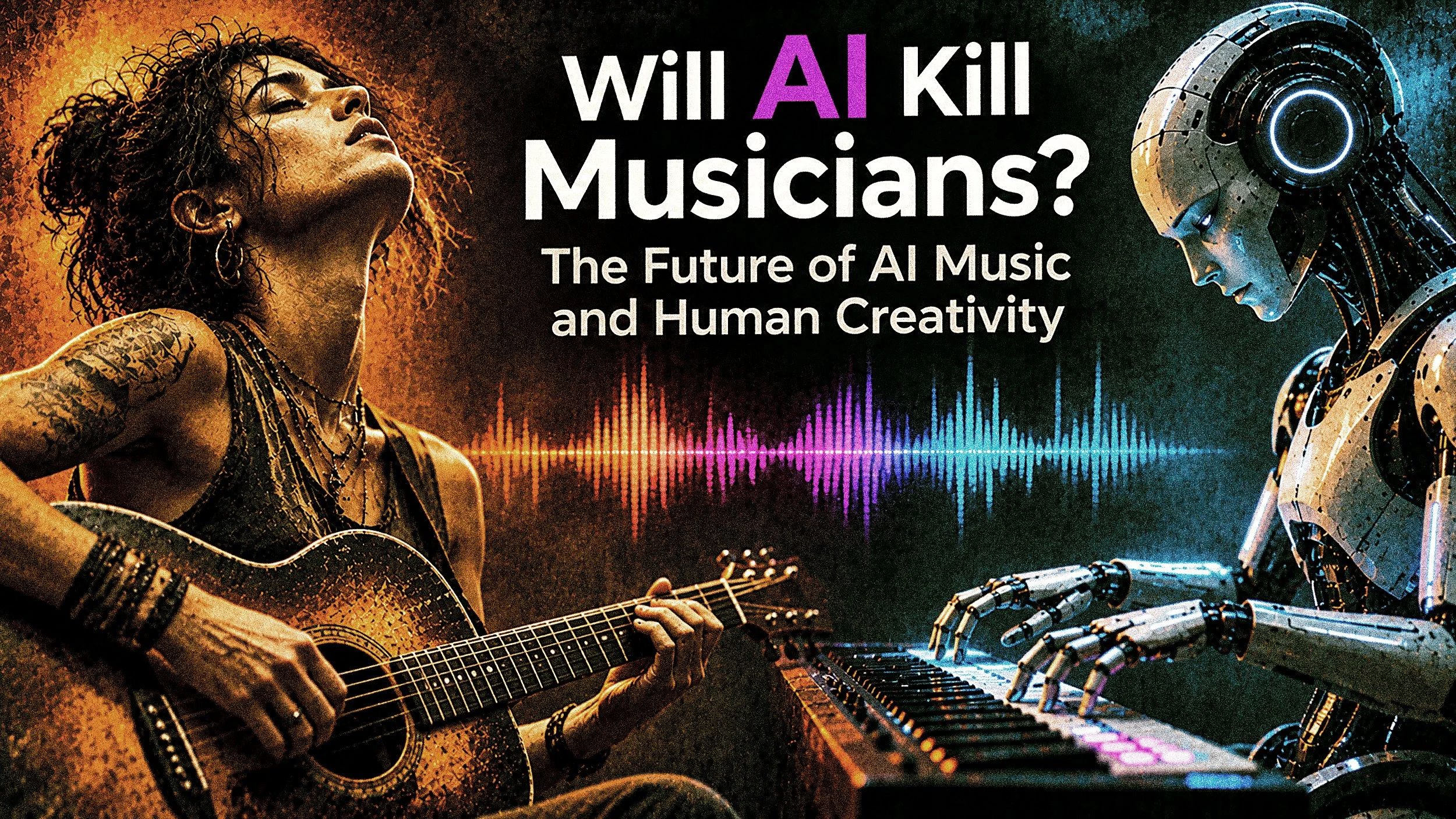
AI isn't going to change what it means to be a musician. A musician is a person who creates music. That's a pretty simple definition, and I don't see generative AI blowing that up in any dramatic way. It will change how some music gets made. It'll change parts of the business, too, and some jobs will disappear while other kinds of work develop around the technology. The basic act of sitting down with an idea and turning it into music isn't going anywhere.
Live music is another part of this that I think gets overlooked. I fucking love live music. The last concert I saw was Paul McCartney in Denver in 2025. Before that, I saw him in Seattle sometime around 1992. In between those two shows, I've seen countless bands and artists perform live. There's still something intoxicating about being in a room with musicians who are really good at what they do. There's actually still a part of me that wants to get back onstage myself, mostly because watching somebody perform at an exceptional level can make you want to go home and pick up your own guitar. Isn't that one of the great things about experiencing art? You see somebody doing something brilliantly, and suddenly you want to try it yourself.
When somebody tells me AI is going to make exceptional musicians irrelevant, I don't buy it. I think the opposite could happen. Watch out, world, when a musician who's already an excellent guitarist, pianist, drummer, singer, or songwriter starts figuring out how to use AI effectively. Think about the analogy I made in my AI art article. Who's likely to get more out of an AI photography tool on day one: someone who knows absolutely nothing about photography, or someone who's spent 20 years learning how light, composition, lenses, and cameras work? The tool gives both people access to extraordinary capabilities, but the experienced photographer already knows what they're looking for. The same thing applies to music.
AI is a boost, but the person using it still brings everything they've learned to the process. A musician who understands harmony, rhythm, arrangement, melody, instrumentation, and performance is going to approach an AI music system with a completely different level of understanding than somebody who knows nothing about music and types a sentence into a box. The second person can absolutely make something great, and that's part of the democratization I've been talking about. Expertise doesn't disappear because the tools become easier to use. In some cases, those new tools may actually make existing expertise more powerful.
I also have a hard time with the idea that music becomes less meaningful because a human isn't physically playing every note. When I listen to music, I'm listening to the music. If I close my eyes and hear something AI-generated that moves me, what exactly am I supposed to be upset about because there wasn't a human sitting behind a guitar amp making the sound? If it sounds good, it sounds good. The emotional response I'm having doesn't suddenly become less real because I know how the sound was produced.
And hell, if somebody eventually creates an AI band with robots that have personalities, stage personas, and their own performances, I think it could become its own thing. It wouldn't be Paul McCartney playing guitar in front of thousands of people, and that's fine. We don't need every new form of musical experience to replace an older one. We've spent the entire history of music inventing new ways to make and experience it. New instruments didn't kill the old ones. Synthesizers didn't eliminate guitars. Drum machines didn't eliminate drummers. Recorded music didn't eliminate live music. Each one opened another door.
I grew up in an era when, if you wanted to make music, you learned to play something. I still have a guitar, and there's something satisfying about actually picking it up and playing it. But if you gave me a machine that allowed me to sit down and create virtually any sound I could imagine, I have to be honest, I might not spend nearly as much time with that guitar. I'm not sure why that should bother anyone. The guitar isn't offended. The music doesn't care. I'd still be making music.
Maybe that's what gets lost in the argument about AI and musicians. People keep treating the tool as though it determines the value of the person using it. It doesn't. A guitar doesn't make you a musician. A piano doesn't make you a musician. A recording studio doesn't make you a musician. AI doesn't make you one either. They're tools. What you do with them is where the interesting part begins.
And the tools are going to keep getting better. They're going to become more responsive, more controllable, and more capable of translating an idea into something you can actually hear. A musician who already understands what they're trying to create will have more ways to explore that idea. A songwriter with 30 years of unfinished material will have more ways to revisit it. Someone who's never written a song before will have a new way into music. There's room for all of that.
That's what I find exciting about where this is going. I've spent decades writing songs, singing, playing guitar, and recording ideas that rarely made it beyond the demo stage. For most of that time, turning those ideas into finished music required money, equipment, other musicians, and access to a studio. A lot of songs simply never got that far. Now the barrier between writing a song and hearing what it can become is much smaller.
I've got roughly five or six albums' worth of material sitting around in various forms, much of it on cassette tapes, notebooks, and old recordings. Those songs existed before AI. I wrote them years or decades ago. Now I can go back through that material and decide which songs still have something to say. I can take one of those old recordings and start building something around it. I can hear what a song might've sounded like if I'd had access to today's technology when I originally wrote it.
That's a pretty extraordinary thing to have access to after spending most of my life writing music. The songs that once lived in notebooks, cassette tapes, and memory can become finished recordings. New songs can take forms that would've been impractical or impossible for me to produce before. Some will work. Some won't. I'll make plenty of crap along the way, too. That's part of making music.
The arguments about AI will continue. There'll be debates about copyright, training data, musicians' jobs, authenticity, ownership, and what happens to the music industry as the technology develops. Those questions deserve serious discussion, particularly when people's livelihoods are involved. But none of them change the fact that AI is now another tool available to people who make music.
For me, that's enough. I've spent decades carrying songs around that I wanted to hear as finished recordings, and now I have a way to do something about it. AI hasn't ended my relationship with music. It has given me another way to continue it. And after all those years of writing songs that might've otherwise remained unheard, I'm perfectly happy to see where this goes.
The Future of AI Music: Why I'm Not Looking Back
AI music is still changing rapidly, and I have no idea where the technology will be in five years, let alone twenty. I expect the tools will become more precise, more responsive, and more capable of producing exactly what someone asks for. I'll probably complain about them anyway when they refuse to put the fucking bass line where I told them to put it.
Apart from the technology, I'm interested in what happens when the barrier between having an idea and actually making something becomes much thinner. I've spent most of my life writing songs in a world where having a song in your head and having a finished recording of that song were two very different things. I'm now living in a world where those two things can get much closer together.
That changes the relationship I have with my own history. Those old songs aren't just relics anymore. I can revisit them without pretending they're all masterpieces, and I can finally decide which ones still have something to say. Some will probably disappoint me. Others may turn out to have been worth keeping. I can live with either answer.
Let everyone work the way they want to work. Spending six months recording an album with a band in a studio is one approach. Making music entirely with AI is another. Using a four-track cassette recorder and a microphone has its own appeal. I've used enough old equipment to know that limitations can sometimes produce interesting results. They can also be a colossal pain in the ass.
I’ve spent decades writing songs, singing, playing guitar, and recording ideas that rarely made it beyond the demo stage. For most of that time, turning those ideas into finished music required money, equipment, other musicians, and access to a studio. A lot of songs simply never got that far. Now the barrier between writing a song and hearing what it can become is much smaller.
That opens up a part of my musical life that has been sitting there for decades. Old songs can be revisited. Half-finished ideas can become recordings. New songs can take forms that would have been impractical or impossible to produce before. Some will work. Some won't. That's part of making music.
The arguments about AI will continue. There will be debates about copyright, training data, musicians' jobs, authenticity, ownership, and what happens to the music industry as the technology develops. Those questions deserve to be argued seriously. None of them change the fact that AI is now another tool available to people who make music.
For me, that means the songs don't have to remain in notebooks, cassette tapes, and memory anymore. They can become recordings. They can become songs that other people can hear. After decades of writing music, that's a pretty remarkable place to end up.
_ _ _
Listen to My Music
I’ve also been making music with AI. You can find the songs on Spotify, Apple Music and YouTube.
BY BOEHMAN
Double-click to edit...