How Did Boehman Music Begin?
There was nothing “Boehman” about the beginning. There were bands. A couple of them.
The first one was called The Dirty Road Poets. We were a three-piece, with me as the singer. The band came together around 1992, when I was 21, after an impromptu jam session in an apartment with a couple of guys who would eventually become the bass player and drummer. I wrote the melodies and lyrics, but I didn't play an instrument and didn't have much to do with the music side of things beyond occasionally offering suggestions about song structure if I happened to be in on the original writing sessions. I was completely invested in the band. The problem was finding other people who were.
The Dirty Road Poets eventually made it as far as two scheduled studio sessions at Triad Studios in Redmond, Washington. We actually recorded six songs, but there wasn't any elaborate production involved. No overdubs, no layers of instrumentation. We simply recorded the three of us playing live because we couldn't afford to do it properly. Those six songs became the entire recorded output of the band. We may have had some rehearsals or jam sessions on cassette, but those six studio tracks were the songs that actually made it out of the room. Eventually, I ended the band because I had become extremely frustrated trying to get other musicians involved and keep the thing moving. I knew that I either needed a solid writing partner or I needed to step up my own game and figure out how to get the music done myself. It seemed futile to continue, much to the dismay of my bass player, who had been a steadfast and slightly fanatical enthusiast about the band.
“Uncle Joe” was written with The Dirty Road Poets. Probably my favorite band-era song.
The next band was Second Cousin, which came together around late 1993. It was basically the same setup: three pieces, with me singing and writing the melodies and lyrics, but still not playing an instrument. We had a professional practice space in Kent, Washington, down in the valley in a very industrialized business park, and we actually paid monthly dues to keep the space. For a while, I thought this might be the version that could actually go somewhere. I could imagine touring. We had better musicians than The Dirty Road Poets, even if I don't think the songs were quite as strong. Our rehearsals and jam sessions eventually produced pseudo-songs that had some structure to them, although they were still basically jams. Unfortunately, the same problem eventually surfaced. People flaked. Second Cousin continued for a few months after my trip to Germany in April 1994, but the writing was already on the wall. The bass player took a new job and wanted to get serious about life, and everyone else was so fucking flaky that it only took one key member stepping away for the whole thing to crumble.
“The Slip” was written with Second Cousin. This song was recovered from a band practice cassette recording.
Germany ended up being more important to my musical life than either band. During that trip, I became friends with a musician named Frank. I've forgotten his surname, but I remember that he was a passionate musician who played bass in a band that was recording its second album. After a drinking session one night, we went back to his place and wrote a song together called “Piss On the Floor,” which I recently revamped into “Kiss On the Floor.” Frank also gave me some advice that stuck with me: pick up a guitar, learn it, and start writing my own music. When I got back, that's what I eventually did. I bought a Taylor six-string acoustic and started figuring out how to write and play for myself. That was a significant change because I was no longer dependent on finding three other people who wanted to make the same music at the same time.
About a year or two later, I spent roughly three or four years in Lake Chelan writing and recording music. I had a lake house to myself and a lot of time to experiment. I bought a digital four-track recorder for around $1,200, which was a fucking fortune at the time, but turned out to be worth every penny in hindsight. I'd messed around with recording technology before, but I wasted no time learning the new equipment as I came across it. I was fascinated by the technology and wanted to understand what I could do with it. A lot of the songs that are now being released as Boehman music came from those years.
That period was also when I started figuring out how to sing. I was trying to write songs in a range that actually worked for my voice while simultaneously figuring out what my voice even was. I didn't really know how to sing properly, so I used that time to experiment. The recording setup itself didn't make things particularly easy. With the equipment I had, I couldn't always sing fully without running into clipping. I didn't have the best microphone setup, and I certainly didn't have anyone sitting beside me monitoring levels or telling me what I was doing wrong. It was all very ragtag, but I was learning by doing it.
More importantly, I began to realize that I was the best advocate for the music I wanted to make. I didn't have to wait for a band to agree that a song was worth pursuing. I could write it, pick up a guitar, record it, and figure out the rest myself. I still liked collaborating with other musicians, and I did whenever I could, but I was no longer dependent on them to keep the music moving. That changed the way I thought about making music, even though I didn't necessarily realize it at the time.
Most of those recordings ended up on cassette, where they stayed for years. Fast forward to 2026, and I still had a box of those cassettes from all those years ago. I started sorting through them and trying to figure out exactly what I had. I'm still cataloguing them now. Around the same time, I learned about Suno and started to understand what was possible with the technology. Suddenly, I had a way to take these old songs and demos and explore what they might sound like as finished recordings. Not necessarily what they should sound like, but what they could sound like if I had the production tools and capabilities back when I originally wrote them.
That became the beginning of the current project. I wasn't sitting on a collection of songs that had been deliberately written for albums. I had decades of unrelated material, some finished, some unfinished, some barely more than ideas, all created at different times and in different places. What I had was an archive. And now I had a way to start going through it.
Why Bring Old Songs Back to Life?
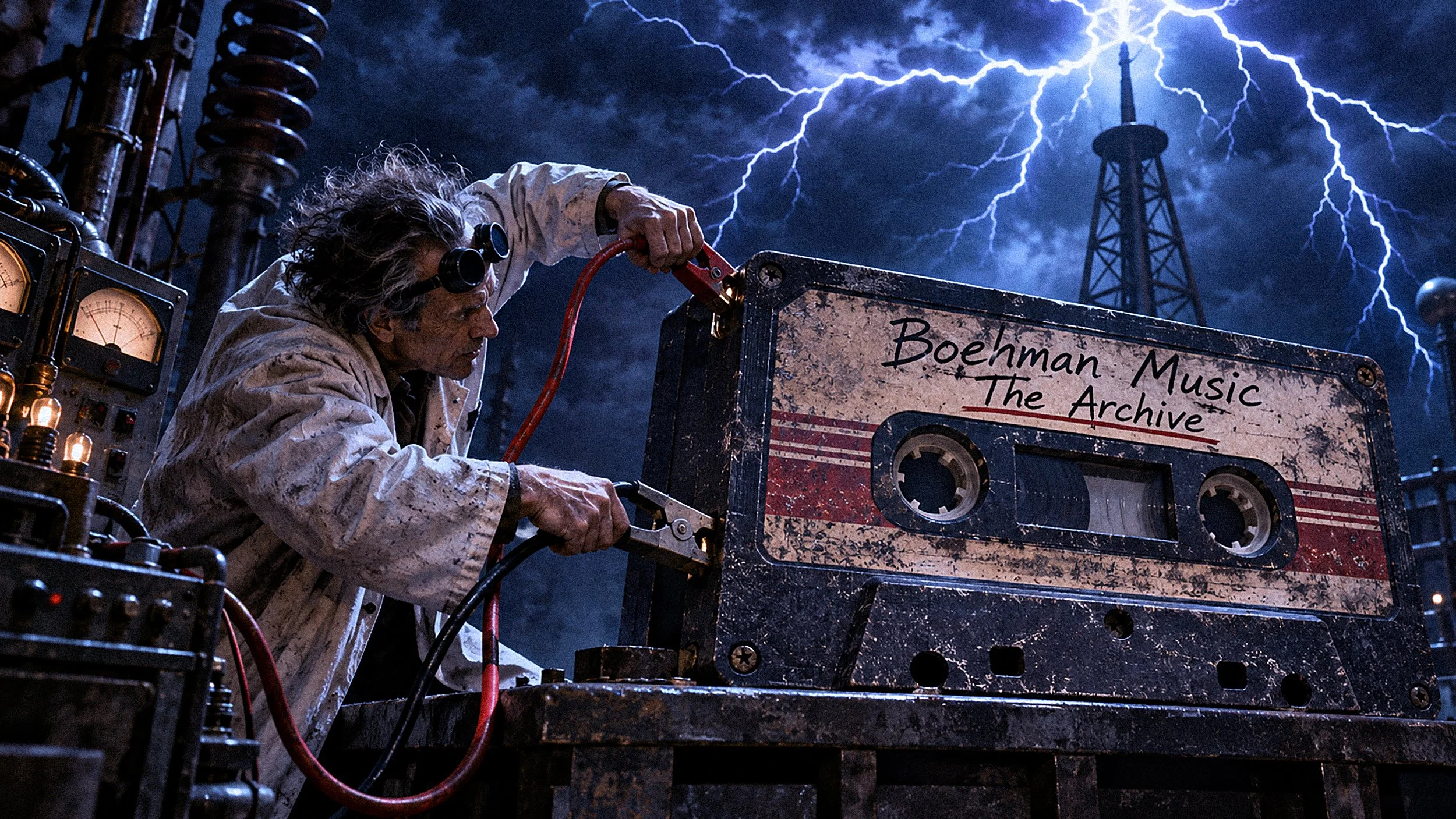
If the expression “chip on my shoulder” had been coined specifically for me this year, it might have said something like: “See Boehman’s regret at not having made it in music.” That is to say, I regret not becoming a musician. It has taken me years to come to terms with that, although I still have some misgivings about it. There was always a part of me that wondered what might have happened if I'd stuck with it, learned more, found the right musicians, written better songs, or simply kept going instead of allowing music to become something I did on the side.
The desire to form a band and actually make a life around music eventually had to go. I'm not interested in trying to recreate that now, and the idea of touring or trying to build a conventional music career doesn't particularly appeal to me anymore. But I discovered that I hadn't necessarily lost the desire to make music. What I'd lost was the need for other people to make it possible. I could write the songs myself, produce them myself, and now, with the technology available to me, take them much further than I ever could before.
The idea of creating a cohesive album, or even simply finishing an album at all, has become a pretty good substitute for the thing I never managed to do. There is something satisfying about taking a group of songs that once existed only as fragments, demos, and ideas and turning them into something complete. In that sense, the albums I'm making now aren't just releases. They're a way of finally finishing something that I started decades ago.
That's essentially what I've done in 2026. I went back into the archive, started recovering the music I'd written over the years, and began turning those old songs into finished recordings. Mixed Tape was the beginning of that process, and Cursing the Blood takes it considerably further. The songs weren't originally written as albums, but putting them together now gives them a kind of destination they never had when I first recorded them.
There is obviously a certain amount of unfinished business in that. I'm not going to pretend otherwise. Part of this project is simply the pleasure of making music again, but part of it is also me finally doing something with all the music that had been sitting around for years. I can't go back and become the musician I might have been at 21 or 25 or 30. What I can do is take the songs I actually wrote, the recordings I actually made, and the ideas that survived all these years, and see what I can make of them now.
How I’m Using AI to Reconstruct the Music
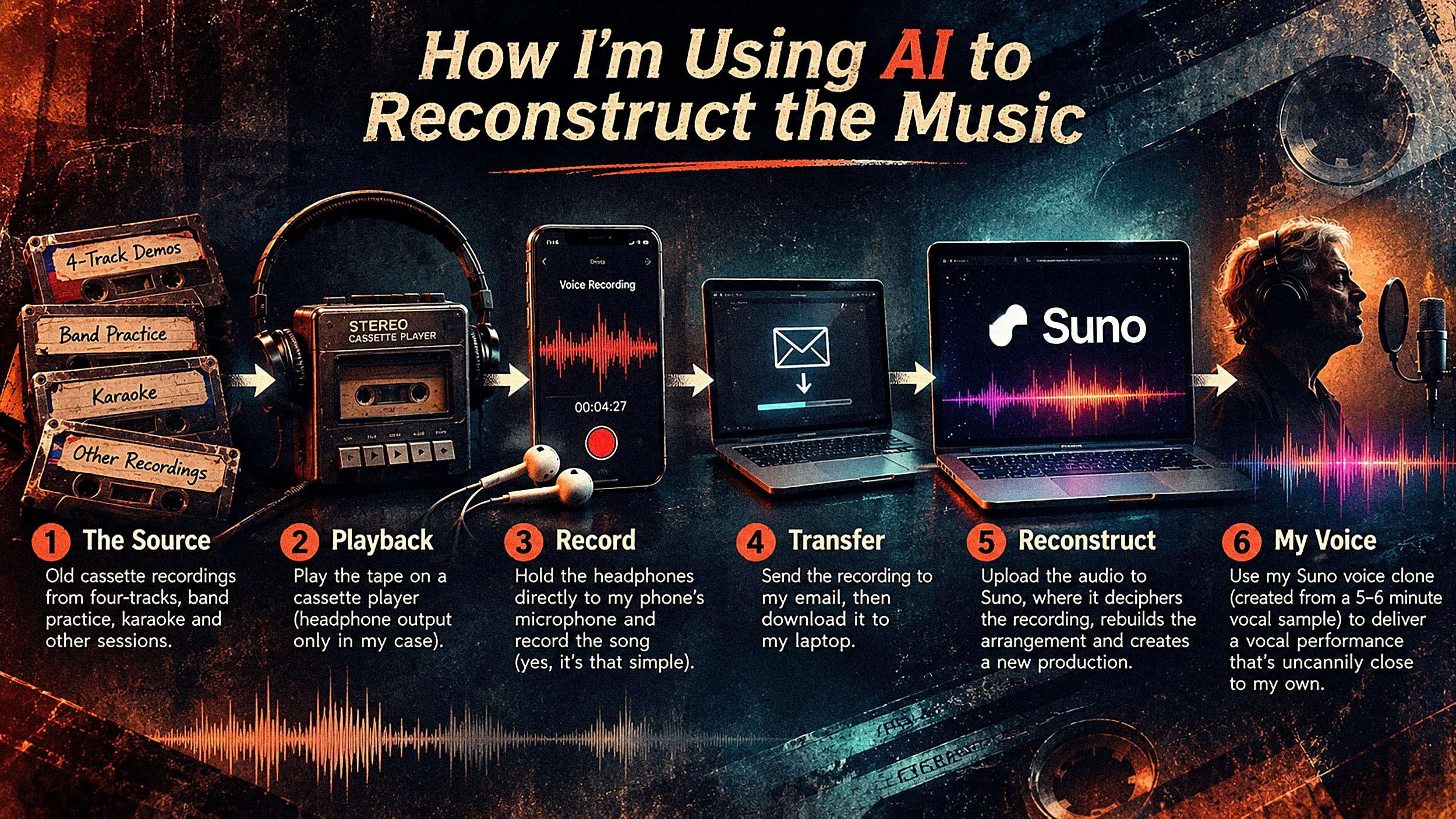
It may sound crazy, but I've fallen into a workflow for bringing these songs back to life. It begins with the cassette tapes themselves. And I'll say this for them: it's pretty fucking amazing that some of these tapes have lasted this long. A few of the tapes I have go all the way back to the 1980s, although those aren't musical recordings. They're mostly me messing around with a microphone, making prank calls, playing DJ and talking over songs, or making up stories. Looking back at those tapes now, I realize I was probably destined to do something with a microphone. The actual songwriting came later.
Most of the music I'm working with came from four-track recordings, but not all of it. Some songs came from other sources, including a karaoke machine and some truly terrible cassette recordings of band practice sessions. Two songs in particular, “The Slip” and “Be My Number,” came from those kinds of recordings. The quality of some of this material is pretty fucking awful, which brings me to the ridiculous way I initially started digitizing it.
I wanted to properly transfer the cassettes into digital files, but I was impatient. Getting the right equipment in India was going to take some time, and I didn't want to wait. I bought a cassette player, but the thing only worked with headphones. Rather than putting the whole project on hold, I came up with a workaround that would probably make an audio engineer cringe. I played the cassette through the headphones, held the earphones directly against the microphone on my phone, and recorded the sound that way using the phone's voice-recording function.
That's right. I was literally holding the headphones against my phone's microphone while listening as carefully as I could for the song to finish. Usually it wasn't much of a problem, although some of the recordings were so fucking quiet that I had to pay close attention to make sure I was actually capturing the whole thing. The resulting recordings were terrible. They were nowhere near what you'd want from a proper digital transfer, and I fully expected that I'd eventually have to go back and do the whole thing properly.
But then I tried feeding one of those shitty phone recordings into Suno.
I was blown away that it worked at all. Somehow, Suno was able to decipher what was buried inside that awful recording and turn it into something that actually sounded like a finished song. Not just a cleaned-up version of the cassette, but a new production built from the musical information it was able to recognize in the recording. That was the moment when the whole process changed for me. I realized I didn't necessarily need to wait for the perfect cassette digitization setup before I could start exploring the archive.
From there, the process became surprisingly simple. I'd play the cassette, record the song to my phone, send the resulting file to myself by email, download it onto my laptop and feed the audio into Suno. From there, I could work with the song and build a new version around what had survived from the original recording. For the vocals, I use Suno's voice cloning feature. I'll sing into the microphone on my computer for roughly five or six minutes, which gives it a good sampling of my voice, and the resulting clone is, frankly, uncanny. In many cases, the resemblance is close enough that hearing it singing one of these old songs can be a strange experience.
There is something pretty satisfying about that whole process. These songs started life as rough recordings made with whatever equipment I happened to have at the time. Some survived on four-track tapes, some on cheap cassettes, and some barely survived at all. Now I'm taking those fragments, feeding them through technology that didn't exist when I made them and finding out what they can become. The fact that the first version of the process involved me holding fucking earphones against my phone microphone only makes it better. I was too impatient to wait for the proper equipment, and that stupid workaround turned out to be enough to get the whole thing started.
Why These Songs Don't Really Belong to Traditional Albums
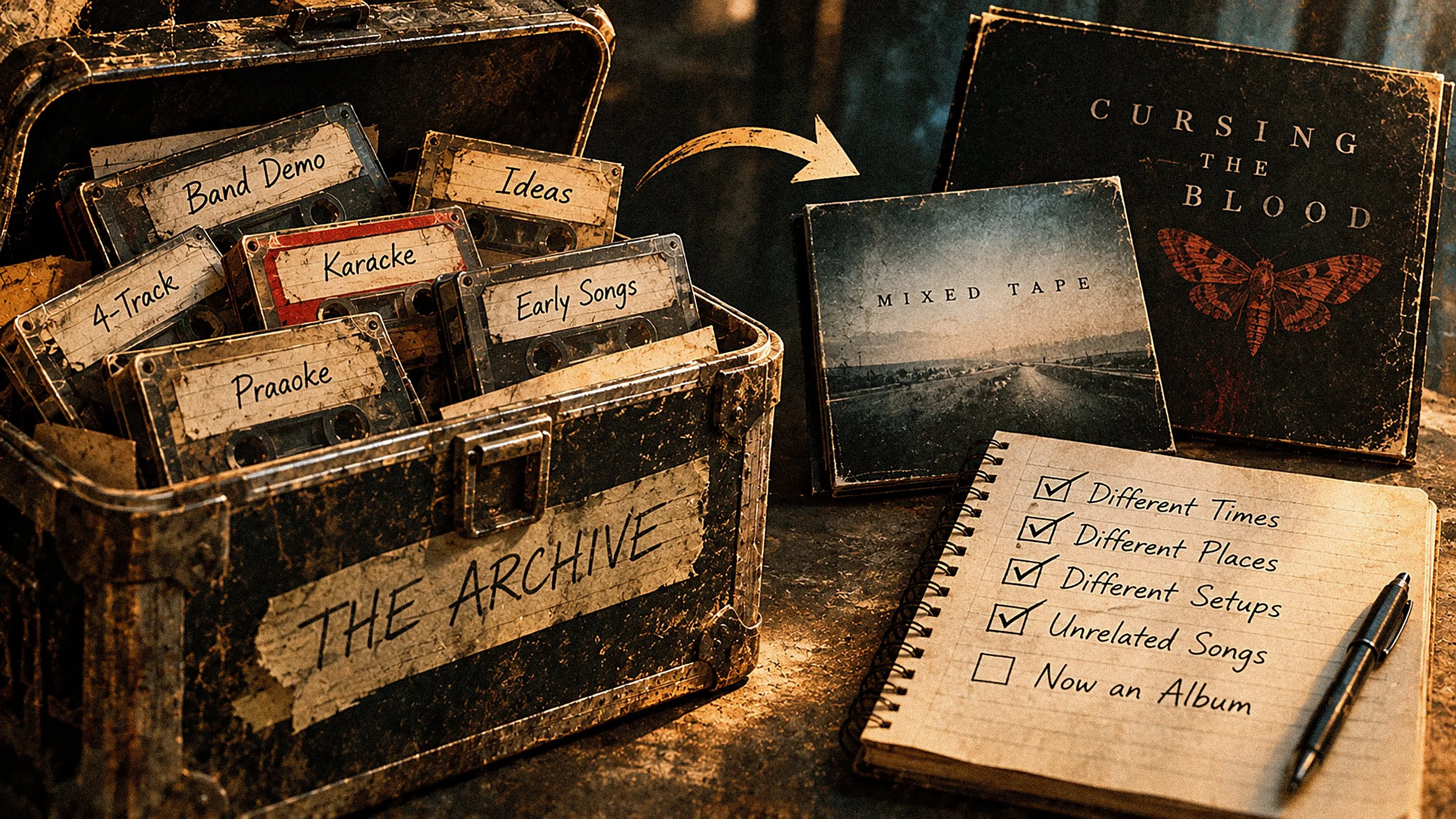
The funny thing about all of this is that I don't really have albums. At least, I didn't start with them. I have songs. Lots of them. They were written at different times, in different places and under completely different circumstances, sometimes years apart. They weren't written with a larger collection in mind, and I certainly wasn't thinking about track sequencing or what would eventually become an album. Most of the time, I was just trying to get the fucking song written.
That creates a slightly strange problem now. Once I started going through the archive, I had to figure out what to do with all of these unrelated songs. I could release them one at a time forever, but that didn't really appeal to me either. Part of what I had been missing all these years was the experience of actually making a record. Not just writing a song, but taking a group of songs and turning them into something that felt finished and existed as a complete thing.
In that sense, making albums has become part of the process itself. I'm creating a relationship between songs that never had one before. Sometimes that relationship is obvious, and sometimes it isn't. I'm not trying to pretend that a song written in one period of my life somehow belongs to a song written ten years later. I'm simply deciding that, at this particular moment, these are the songs I want to put together and call a record.
That's what Mixed Tape was. The name was almost a joke, because it acknowledged exactly what I was doing. These weren't songs that had been carefully conceived as an album. They were songs pulled from different parts of my musical history and brought together into one release. Cursing the Blood follows the same basic idea, only on a much larger scale. Thirty-five tracks is obviously not a conventional album, but then again, I don't really have conventional circumstances behind any of this.
There is something satisfying about finally giving these songs a home. For years they existed as individual recordings, some of them barely more than fragments sitting on a cassette. Now they can exist as finished songs and, eventually, as collections of songs that people can actually listen to. The albums aren't necessarily the way these songs were meant to exist when I wrote them. They're the way I've decided to let them exist now.
Maybe that's an important distinction. I'm not reconstructing the past exactly as it was. I'm taking what survived from it and deciding what to do with it now. The archive gave me the songs. 2026 gave me the ability to finish them. The albums are what happened when I put the two together.
What Happens Next?
The first releases are going to be built largely from the archive. Mixed Tape is the beginning of that process, and Cursing the Blood takes it considerably further. Between those releases and everything still sitting in the archive, there is enough material to keep me busy for quite a while. I have songs from different periods of my life, different recording setups and different levels of completeness, and I still don't know exactly how much of it is worth bringing back. That's part of the fun of finding out.
But I don't want Boehman Music to become an archaeological project where I'm spending the rest of my life digging through old cassettes and trying to resurrect whatever I can find. At some point, I want to make an album that has nothing to do with archaeology. I want to make a purposeful record from the ground up, the way I imagine I would have done it if I'd been in a studio band with the right musicians, the right studio and the time to actually make a record together. Songs written for the album. A sound developed for the album. Arrangements that belong together. The whole thing conceived as a record rather than assembled afterward from whatever happens to be sitting in the archive.
That's something I couldn't really do when I was younger. I was always trying to get the musicians together, trying to keep a band alive, trying to find the right circumstances to make the music happen. Now I can approach it completely differently. I have the experience of all those years of writing and recording, and I have access to production tools that I could never have imagined when I was making four-track tapes in Lake Chelan. I can finally make the kind of album I used to imagine making.
I'll be writing about that process here as the journal continues. I'll get into the individual albums, the songs, the recordings they came from, the production experiments and eventually what happens when I stop looking backward and start building something entirely new. I don't know exactly what that record will sound like yet, and I don't particularly want to decide before I make it. That's part of the point.
For now, I'm still in the archive. There are a lot of songs waiting to be heard, and I'm having a fucking great time finding out what's in there. But the archive is only the beginning. The real test, and probably the more interesting part, will be seeing what happens when I stop recovering the music I already made and start making the music I want to make now.
Double-click to edit...